
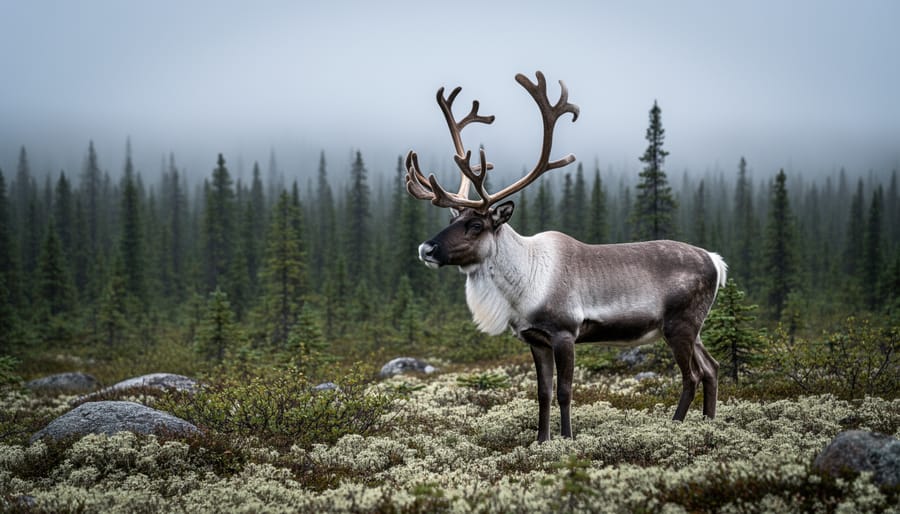

Mammal habitat is the complete physical environment where a species lives, feeds, breeds, and finds shelter, encompassing everything from the soil composition and vegetation structure to water sources and the presence of other species that form the ecological web. In Canada, these habitats range from coastal rainforests sheltering black bears and Roosevelt elk to Arctic tundra sustaining polar bears and caribou, and each component plays a vital role in species survival. Understanding what makes habitat functional matters because protecting land alone isn’t enough. A woodland caribou needs mature boreal forest with specific lichen growth for winter feeding, minimal human disturbance for calving, and connectivity to other populations for genetic health.
Across Canada’s vast landscapes, habitat loss and fragmentation remain the primary threats to mammal populations. When highways bisect migration corridors or urban sprawl replaces wetlands, species lose more than space. They lose the intricate relationships between shelter, food, breeding grounds, and seasonal movement patterns that have sustained them for millennia.
Yet the story isn’t one of inevitable decline. Conservation efforts grounded in habitat science have brought species back from the brink. In Ontario, targeted wetland restoration has helped muskrat and beaver populations rebound. In British Columbia, wildlife corridor projects now guide grizzly bears safely across the Trans-Canada Highway. These successes share a common thread: they recognize that saving mammals means saving the complete, functioning ecosystems they call home. For anyone looking to support wildlife conservation, understanding habitat is where meaningful action begins.
What Defines Mammal Habitat in Canadian Ecosystems
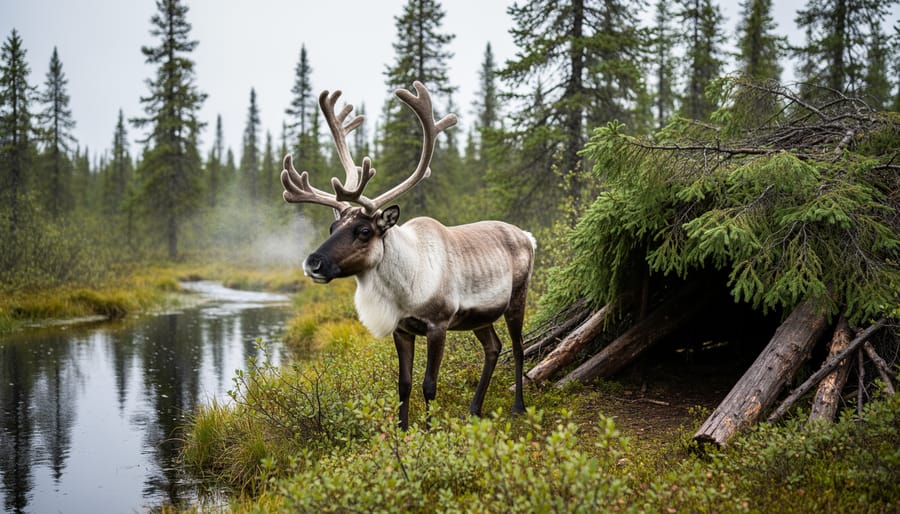
Mammal habitat encompasses five essential elements that determine whether a species can survive and reproduce in a given area. In Canadian ecosystems, these components manifest in distinct ways depending on the landscape, but every mammal requires the same fundamental resources: adequate food, suitable shelter, accessible water, sufficient space, and safe breeding grounds.
Food sources vary dramatically across Canada’s ecological zones. A grizzly bear in British Columbia’s coastal forests relies on salmon runs, berry patches, and ungulate prey, while an Arctic fox on the tundra hunts lemmings and scavenges marine mammal carcasses. The seasonal availability of food shapes mammal behaviour, many species migrate, hibernate, or cache resources to cope with Canada’s harsh winters when food becomes scarce.
Shelter provides protection from predators, extreme weather, and human disturbance. This might be a wolverine’s den beneath snow-covered boulders in the Yukon, a beaver’s lodge in a Saskatchewan wetland, or the thick understory vegetation where woodland caribou bed down. The quality of shelter directly affects survival rates, particularly during vulnerable periods like raising young or weathering winter storms.
Water accessibility matters even in Canada’s water-rich landscapes. Desert-adapted species like bighorn sheep in the southern interior require reliable water sources within their range, while semi-aquatic mammals such as muskrats and otters need permanent water bodies that don’t freeze completely.
Space requirements differ vastly by species. A single male cougar may patrol a territory of 200 square kilometres in the Rocky Mountains, while a family of short-tailed weasels operates in just a few hectares. Population density, prey availability, and habitat quality all influence how much space mammals need.
Breeding grounds must offer safety and resources during the energy-intensive reproductive period. Polar bears return to traditional denning areas on sea ice and coastal zones, while elk seek high-elevation meadows for calving. These elements don’t function in isolation, they form an interconnected system where degradation of one component compromises the entire habitat’s viability.
Canada’s Major Mammal Habitat Types and Species
Boreal Forest and Woodland Habitats
Canada’s boreal forest stretches across nearly 60% of the nation’s land mass, creating the largest intact forest ecosystem on Earth. This vast woodland provides critical habitat for species that have adapted to its cold winters, short summers, and dense coniferous cover.
The boreal supports woodland caribou, lynx and wolverines that rely on its remote, undisturbed expanses. Woodland caribou need old-growth stands with abundant ground lichens for winter forage, plus peatlands and bogs where they can escape predators during calving season. Canada lynx hunt snowshoe hares through thick spruce and pine, while wolverines range across hundreds of square kilometres, denning in areas with deep, persistent snowpack.
Black bears thrive here too, foraging on berries, roots, and insects in forest clearings and along wetland edges. The boreal’s mosaic of lakes, rivers, wetlands, and upland forest creates the shelter, food sources, and breeding sites these mammals require. Its sheer scale offers space for wide-ranging species, but logging, oil and gas development, and road construction increasingly fragment this once-continuous wilderness, making habitat protection urgent for boreal-dependent mammals.
Grassland and Prairie Habitats
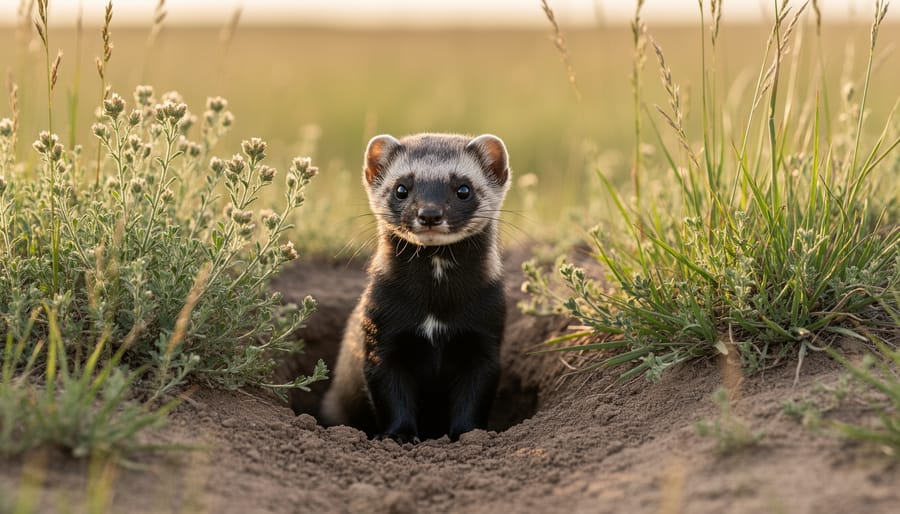
Canada’s grasslands once blanketed vast stretches of the southern prairies, creating a complex ecosystem where mixed-grass and shortgrass species provided shelter and food for specialized mammals. These open landscapes supported swift foxes that den in abandoned badger holes and hunt ground squirrels across the rolling terrain. Black-footed ferrets, North America’s most endangered mammal, evolved to depend almost entirely on prairie dog colonies, using their burrows for shelter and preying on them for sustenance.
Pronghorn antelopes, uniquely adapted to this habitat, rely on unobstructed sightlines to detect predators and require large territories to access seasonal forage. The prairie ecosystem functions as an interconnected web where burrowing mammals create homes for others, native grasses sustain herbivores, and predators maintain population balance. Today, less than 20% of Canada’s original grasslands remain intact, making prairie habitat among the nation’s most threatened ecosystems, critical not only for these distinctive mammals but also for endangered pollinators and ground-nesting birds that share this vanishing landscape.
Coastal and Marine-Adjacent Habitats
Canada’s coastal zones create unique habitats where land and sea converge, supporting mammals with specialized adaptations. These environments include rocky shorelines, tidal flats, ice shelves, kelp forests, and beaches that serve as critical transition zones between marine and terrestrial ecosystems.
Sea otters inhabit kelp forest ecosystems along British Columbia’s coast, requiring nearshore waters with abundant shellfish and protective kelp canopy. These mammals need coastal areas where they can access food within their diving range while sheltering from storms in protected bays.
Polar bears depend on sea ice as hunting platforms for seals, but terrestrial coastal habitat becomes essential during ice-free periods. Denning sites along Arctic coastlines provide shelter for mothers raising cubs, while coastal zones offer refuge and limited foraging opportunities when ice recedes earlier each year due to warming temperatures.
Marine mammals like seals and sea lions require terrestrial haul-out sites for rest, breeding, and pupping. Rocky islands, sandbars, and beaches serve these needs, offering safety from aquatic predators and space for social interactions.
These coastal habitats face pressures from shipping traffic, coastal development, pollution, and rapidly changing ice conditions, making their protection crucial for species that cannot survive without access to both marine and terrestrial resources.
Threats to Mammal Habitat Across Canada
Canada’s mammal habitats face mounting pressures that threaten the survival of species from coast to coast. While conservation efforts have achieved notable successes, the scale and complexity of habitat degradation demand urgent attention and sustained action.
Urban and Agricultural Expansion
Development remains the most visible threat to mammal habitat across southern Canada. Cities expand into surrounding lands, converting forests, wetlands, and grasslands into residential neighbourhoods, commercial zones, and transportation networks. Agricultural intensification has transformed vast stretches of native prairie into monoculture cropland, eliminating the diverse plant communities that supported swift foxes, badgers, and ground squirrels. In British Columbia’s Fraser Valley, urban sprawl has reduced critical wetland habitat for river otters and muskrats by over 80% since the 1800s. The pace shows no signs of slowing, with projections indicating continued loss of natural areas surrounding major metropolitan centres.
Resource Extraction and Industrial Activity
Mining, oil and gas development, and forestry operations fragment and degrade habitats across Canada’s northern reaches. Seismic lines cut through boreal forests, creating corridors that predators use to access caribou more easily. Open-pit mines eliminate habitat entirely, while tailings ponds and processing infrastructure create barriers to mammal movement. In Alberta’s oil sands region, industrial footprints have altered more than 840 square kilometres of woodland caribou habitat. Logging operations, when not carefully managed, remove the old-growth forests that martens, fishers, and flying squirrels require for denning and foraging.
Climate Change Impacts
Rising temperatures are reshaping habitats faster than many mammals can adapt. Polar bears face shrinking sea ice that limits their access to seal hunting grounds. Warmer winters cause freeze-thaw cycles that lock caribou out of their lichen food sources beneath ice crusts. Southern species like white-tailed deer are expanding northward into moose and caribou territory, bringing parasites and increasing competition. Shifting vegetation zones alter the distribution of browse and prey species, forcing mammals to relocate or face nutritional stress.
Habitat Fragmentation
Roads, railways, pipelines, and power lines carve continuous habitats into isolated patches. Grizzly bears need vast territories to find sufficient food, but highways and fences restrict their movement between mountain valleys. Fragmentation prevents genetic exchange between populations, increasing inbreeding risks and reducing species’ ability to recover from local declines. It also amplifies “edge effects,” where invasive species, predators, and human disturbance penetrate deeper into remaining habitat fragments.
How Mammal Preservation Initiatives Protect and Restore Habitat
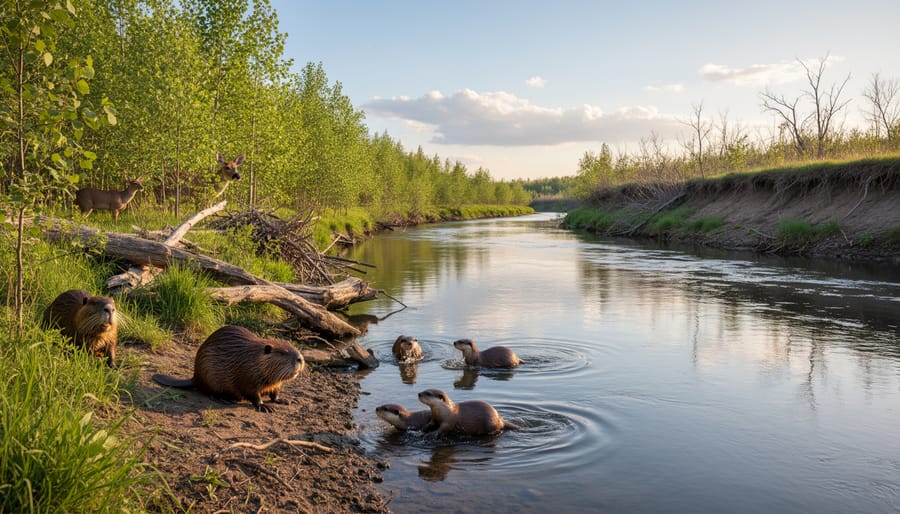
Protecting and restoring mammal habitat demands coordinated action across multiple fronts, from establishing permanent refuges to reconnecting fractured landscapes. Conservation organizations and government agencies deploy several proven strategies that address both immediate threats and long-term habitat security.
Protected areas form the cornerstone of habitat conservation in Canada. National parks, provincial wilderness reserves, and wildlife management areas permanently safeguard critical spaces where mammals can feed, breed, and shelter without human interference. These designated zones range from small remnants protecting specific denning sites to vast northern expanses preserving entire ecosystems. For species like woodland caribou, whose Recovery Strategy includes critical habitat identification, protected areas provide the undisturbed old-growth forest needed for calving and winter survival.
Habitat corridors address one of the most pressing threats to mammal populations: fragmentation. By creating or maintaining connected pathways between isolated habitat patches, corridors allow animals to move safely across landscapes increasingly divided by roads, agriculture, and development. These wildlife passages enable genetic exchange between populations, provide access to seasonal resources, and give species flexibility to shift ranges as climate conditions change. Grizzly bears in the Yellowstone to Yukon corridor, for instance, rely on these connected landscapes to access feeding areas and find mates across their enormous territories.
Active habitat restoration projects repair damaged ecosystems and recreate conditions mammals need to thrive. Restoration work includes replanting native vegetation that provides food and cover, removing invasive species that degrade habitat quality, restoring wetlands that serve as water sources, and rehabilitating stream banks that stabilize riparian zones. Prairie grassland restoration efforts have reestablished thousands of hectares of habitat for swift foxes and other species displaced by agricultural conversion.
Land stewardship partnerships extend conservation beyond public lands by working with private landowners, Indigenous communities, and industry stakeholders. Conservation easements protect habitat on private property while allowing continued ownership. Stewardship agreements encourage habitat-friendly practices on working landscapes. These collaborative approaches recognize that effective mammal preservation requires protecting habitat wherever it exists, not just within park boundaries. Many of Canada’s most critical habitats fall outside protected areas, making these partnerships essential for species survival across the broader landscape.
Success Stories: Habitat Conservation in Action
When prairie grasslands in southern Saskatchewan began recovering in the early 2000s, something remarkable happened: swift foxes started reclaiming territory their ancestors hadn’t seen in decades. The Grasslands National Park expansion project combined protected land acquisition with active habitat restoration, removing invasive species and reintroducing native grasses. Volunteers spent hundreds of hours collecting and planting native seeds, creating the short-grass prairie conditions swift foxes need for denning and hunting. Today, the population has grown from a handful of reintroduced animals to over 600 individuals across the prairies, a testament to what focused habitat work can achieve.
Up in the boreal forests of northern Ontario, the Woodland Caribou Provincial Park partnership took a different approach. Rather than just designating protected areas, conservation groups worked with forestry companies to create buffer zones and modify harvesting practices around critical caribou calving grounds. Local Indigenous communities contributed traditional knowledge about caribou movement patterns, helping identify which forest patches needed protection most urgently. The collaboration resulted in 450,000 hectares of managed habitat where caribou herds have stabilized after years of decline.
Alberta’s Waterton-Glacier International Peace Park demonstrates how cross-border cooperation protects wide-ranging species. Grizzly bears don’t respect political boundaries, so habitat corridors linking the park to surrounding wilderness allow bears to move safely between territories. Trail cameras document successful crossings, and volunteers monitor these pathways to ensure they remain functional. The connected landscape now supports one of North America’s healthiest grizzly populations.
On Vancouver Island, volunteers with the Marmot Recovery Foundation helped bring the Vancouver Island marmot, one of Canada’s rarest mammals back from fewer than 30 individuals in 2003. Beyond captive breeding, teams restored high-elevation meadow habitat by clearing encroaching conifers and creating suitable burrow sites. Local hiking groups adopted monitoring roles, reporting marmot sightings and helping maintain cleared areas. The population now exceeds 200 wild marmots, proof that habitat quality matters as much as species numbers.
These successes share common threads: they combined scientific expertise with community action, addressed specific habitat needs rather than generic protection, and maintained long-term commitment beyond initial victories.
Common Questions About Mammal Habitat and Conservation
How does habitat loss directly affect mammal populations?
When mammals lose habitat, they face immediate challenges finding adequate food, shelter, and breeding sites, which reduces survival rates and reproductive success. Fragmented habitats also isolate populations, limiting genetic diversity and making species more vulnerable to disease and environmental changes.
How much habitat does a species actually need to survive?
Habitat requirements vary dramatically by species. A woodland caribou herd may need thousands of square kilometres of undisturbed boreal forest, while smaller mammals like shrews can thrive in much tighter spaces. The key isn’t just size but quality, connectivity to other habitat patches, and freedom from disturbance during critical periods like breeding and migration.
What can individuals realistically do to protect mammal habitat?
You can support habitat conservation by volunteering with restoration projects, choosing products from companies committed to sustainable land use, and advocating for protected areas in your region. Even small actions like maintaining natural vegetation on your property or supporting preservation initiatives through donations create tangible impact.
How are habitat protection projects funded and prioritized?
Conservation organizations typically prioritize habitats based on species at risk, ecosystem health, and threat urgency, securing funding through government grants, private donations, corporate partnerships, and land trusts. Projects protecting habitat for multiple species or addressing imminent threats like development usually receive priority, though funding remains a constant challenge across Canada’s vast landscapes.
These questions reflect concerns we hear constantly from people discovering their connection to wildlife conservation. The answers might seem straightforward, but they open doors to deeper understanding. Recognizing that habitat needs aren’t one-size-fits-all helps explain why conservation strategies differ so dramatically between protecting Arctic-dwelling polar bears and grassland swift foxes. The funding question matters because transparency builds trust, and when people see how their contributions translate into acres protected or corridors established, they’re more likely to stay engaged long-term. Real habitat conservation isn’t abstract policy work happening somewhere distant. It’s boots-on-the-ground restoration, careful monitoring, and communities deciding that the mammals sharing their landscapes deserve space to thrive.
How You Can Support Mammal Habitat Conservation
Every Canadian can play a meaningful role in protecting the spaces our wildlife depends on. Your involvement doesn’t require expertise, just commitment and a willingness to take action.
Join Habitat Restoration Projects
Volunteer programs across the country need hands-on help restoring degraded habitats. Plant native trees and shrubs that provide food and shelter for mammals, remove invasive species choking out essential vegetation, or participate in prairie restoration efforts. Wild Canada Preservation coordinates volunteer days throughout the year, offering training and connecting you with projects that match your schedule and location. Even a few hours spent planting seedlings or clearing debris creates tangible improvements for local wildlife.
Support Conservation Through Strategic Giving
Financial contributions fund the acquisition and long-term management of critical habitat. Look for organizations working on landscape-scale conservation projects that protect migration corridors and breeding grounds. Wild Canada Preservation channels donations directly into habitat protection initiatives, with transparent reporting on how funds create lasting change. Consider monthly giving for sustained impact, or dedicate contributions to specific habitat types that resonate with you.
Practice Habitat-Friendly Land Stewardship
If you own property, keep portions wild rather than manicuring every square metre. Leave brush piles for small mammals, maintain native plants, and create buffer zones along waterways. Reduce pesticide use that eliminates the insects many mammals feed on. Urban and suburban yards collectively represent significant potential habitat when managed thoughtfully.
Advocate for Protected Areas
Contact your MP and provincial representatives supporting proposed protected areas and habitat conservation legislation. Attend public consultations about land use decisions affecting wildlife corridors. Your voice shapes policy outcomes that determine whether critical habitats receive legal protection or face development pressure.
Canada’s mammal populations depend entirely on the integrity of their habitats. Every woodland caribou, every prairie swift fox, every coastal sea otter needs space configured to meet its specific requirements for food, shelter, breeding, and movement. When we protect and restore these habitats, we give these species the foundation they need to survive and flourish.
The conservation progress already underway across Canada demonstrates what’s possible when communities, organizations, and governments commit to habitat preservation. Restored prairie grasslands now support recovering swift fox populations. Protected boreal corridors allow woodland caribou to move between fragmented ranges. Coastal restoration projects have created safer havens for marine mammals coming ashore.
Yet enormous challenges remain. Climate change continues altering ecosystems faster than many species can adapt. Development pressures fragment critical habitats. Restoration projects require sustained funding and volunteer effort over decades, not months.
This is where individual action becomes essential. Whether you contribute expertise to habitat surveys, support organizations working on land protection, participate in restoration plantings, or advocate for stronger habitat safeguards, your involvement matters. Conservation gains emerge from thousands of people making deliberate choices to prioritize habitat protection.
The mammals sharing Canada’s landscapes with us can’t secure their own future. They need functioning ecosystems maintained through intentional stewardship. By understanding what constitutes mammal habitat and committing to its preservation, we ensure that future generations inherit a Canada still populated by the remarkable diversity of mammals that define this nation’s wild character.